
14 African Countries Forced by France to Pay Colonial Tax For the Benefits of Slavery and Colonization
By Mawuna Remarque KOUTONIN*
 Did
you know many African countries continue to pay colonial tax to France
since their independence till today!When Sékou Touré of Guinea decided
in 1958 to get out of french colonial empire, and opted for the country
independence, the french colonial elite in Paris got so furious, and in a
historic act of fury the french administration in Guinea
destroyed everything in the country which represented what they called
the benefits from french colonization.
Did
you know many African countries continue to pay colonial tax to France
since their independence till today!When Sékou Touré of Guinea decided
in 1958 to get out of french colonial empire, and opted for the country
independence, the french colonial elite in Paris got so furious, and in a
historic act of fury the french administration in Guinea
destroyed everything in the country which represented what they called
the benefits from french colonization.
Three thousand French left the country, taking all their property and destroying anything that which could not be moved: schools, nurseries, public administration buildings were crumbled; cars, books, medicine, research institute instruments, tractors were crushed and sabotaged; horses, cows in the farms were killed, and food in warehouses were burned or poisoned.
The purpose of this outrageous act was to send a clear message to all other colonies that the consequences for rejecting France would be very high.
Slowly fear spread trough the african elite, and none after the Guinea events ever found the courage to follow the example of Sékou Touré, whose slogan was “We prefer freedom in poverty to opulence in slavery.”
Sylvanus Olympio, the first president of the Republic of Togo, a tiny country in west Africa, found a middle ground solution with the French.He didn’t want his country to continue to be a french dominion, therefore he refused to sign the colonisation continuation pact De Gaule proposed, but agree to pay an annual debt to France for the so called benefits Togo got from french colonization.It was the only conditions for the French not to destroy the country before leaving. However, the amount estimated by France was so big that the reimbursement of the so called “colonial debt” was close to 40% of the country budget in 1963.
The financial situation of the newly independent Togo was very unstable, so in order to get out the situation, Olympio decided to get out the french colonial money FCFA (the franc for french african colonies), and issue the county own currency.
On January 13, 1963, three days after he started printing his country own currency, a squad of illiterate soldiers backed by France killed the first elected president of newly independent Africa. Olympio was killed by an ex French Foreign Legionnaire army sergeant called Etienne Gnassingbe who supposedly received a bounty of $612 from the local French embassy for the hit man job.
Olympio’s dream was to build an independent and self-sufficient and self-reliant country. But the French didn’t like the idea.
On June 30, 1962, Modiba Keita , the first president of the Republic of Mali, decided to withdraw from the french colonial currency FCFA which was imposed on 12 newly independent African countries. For the Malian president, who was leaning more to a socialist economy, it was clear that colonisation continuation pact with France was a trap, a burden for the country development.
On November 19, 1968, like, Olympio, Keita will be the victim of a coup carried out by another ex French Foreign legionnaire, the Lieutenant Moussa Traoré.
In fact during that turbulent period of African fighting to liberate themselves from European colonization, France would repeatedly use many ex Foreign legionnaires to carry out coups against elected presidents:
Number of Coups in Africa by country
Ex French colonies Other African countries Country Number of coup Country number of coup Togo 1 Egypte 1 Tunisia 1 Libye 1 Cote d’Ivoire 1 Equatorial Guinea 1 Madagascar 1 Guinea Bissau 2 Rwanda 1 Liberia 2 Algeria 2 Nigeria 3 Congo – RDC 2 Ethiopia 3 Mali 2 Ouganda 4 Guinea Conakry 2 Soudan 5 SUB-TOTAL 1 13
Congo 3
Tchad 3
Burundi 4
Central Africa 4
Niger 4
Mauritania 4
Burkina Faso 5
Comores 5
SUB-TOTAL 2 32
TOTAL (1 + 2) 45 TOTAL 22
As these numbers demonstrate, France is quite desperate but active to keep a strong hold on his colonies what ever the cost, no matter what.
In March 2008, former French President Jacques Chirac said:
“Without Africa, France will slide down into the rank of a third [world] power”
Chirac’s predecessor François Mitterand already prophesied in 1957 that:
”Without Africa, France will have no history in the 21st century”
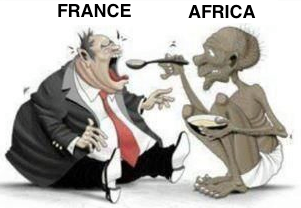
At this very moment I’m writing this article, 14 african countries are obliged by France, trough a colonial pact, to put 85% of their foreign reserve into France central bank under French minister of Finance control. Until now, 2014, Togo and about 13 other african countries still have to pay colonial debt to France. African leaders who refuse are killed or victim of coup. Those who obey are supported and rewarded by France with lavish lifestyle while their people endure extreme poverty, and desperation.
It’s such an evil system even denounced by the European Union, but France is not ready to move from that colonial system which puts about 500 billions dollars from Africa to its treasury year in year out.
We often accuse African leaders of corruption and serving western nations interests instead, but there is a clear explanation for that behavior. They behave so because they are afraid the be killed or victim of a coup. They want a powerful nation to back them in case of aggression or trouble. But, contrary to a friendly nation protection, the western protection is often offered in exchange of these leaders renouncing to serve their own people or nations’ interests.
African leaders would work in the interest of their people if they were not constantly stalked and bullied by colonial countries.
In 1958, scared about the consequence of choosing independence from France, Leopold Sédar Senghor declared: “The choice of the Senegalese people is independence; they want it to take place only in friendship with France, not in dispute.”
From then on France accepted only an “independence on paper” for his colonies, but signed binding “Cooperation Accords”, detailing the nature of their relations with France, in particular ties to France colonial currency (the Franc), France educational system, military and commercial preferences.
Below are the 11 main components of the Colonisation continuation pact since 1950s:
#1. Colonial Debt for the benefits of France colonizationThe newly “independent” countries should pay for the infrastructure built by France in the country during colonization.
I still have to find out the complete details about the amounts, the evaluation of the colonial benefits and the terms of payment imposed on the african countries, but we are working on that (help us with info).
#2. Automatic confiscation of national reservesThe African countries should deposit their national monetary reserves into France Central bank.
France has been holding the national reserves of fourteen african countries since 1961: Benin, Burkina Faso, Guinea-Bissau, Ivory Coast, Mali, Niger, Senegal, Togo, Cameroon, Central African Republic, Chad, Congo-Brazzaville, Equatorial Guinea and Gabon.
“The monetary policy governing such a diverse aggregation of countries is uncomplicated because it is, in fact, operated by the French Treasury, without reference to the central fiscal authorities of any of the WAEMU or the CEMAC. Under the terms of the agreement which set up these banks and the CFA the Central Bank of each African country is obliged to keep at least 65% of its foreign exchange reserves in an “operations account” held at the French Treasury, as well as another 20% to cover financial liabilities.
The CFA central banks also impose a cap on credit extended to each member country equivalent to 20% of that country’s public revenue in the preceding year. Even though the BEAC and the BCEAO have an overdraft facility with the French Treasury, the drawdowns on those overdraft facilities are subject to the consent of the French Treasury. The final say is that of the French Treasury which has invested the foreign reserves of the African countries in its own name on the Paris Bourse.
In short, more than 80% of the foreign reserves of these African countries are deposited in the “operations accounts” controlled by the French Treasury. The two CFA banks are African in name, but have no monetary policies of their own. The countries themselves do not know, nor are they told, how much of the pool of foreign reserves held by the French Treasury belongs to them as a group or individually.
The earnings of the investment of these funds in the French Treasury pool are supposed to be added to the pool but no accounting is given to either the banks or the countries of the details of any such changes. The limited group of high officials in the French Treasury who have knowledge of the amounts in the “operations accounts”, where these funds are invested; whether there is a profit on these investments; are prohibited from disclosing any of this information to the CFA banks or the central banks of the African states .” Wrote Dr. Gary K. Busch
It’s now estimated that France is holding close to 500 billions African countries money in its treasury, and would do anything to fight anyone who want to shed a light on this dark side of the old empire.
The African countries don’t have access to that money.
France allows them to access only 15% of the money in any given year. If they need more than that, they have to borrow the extra money from their own 65% from the French Treasury at commercial rates.
To make things more tragic, France impose a cap on the amount of money the countries could borrow from the reserve. The cap is fixed at 20% of their public revenue in the preceding year. If the countries need to borrow more than 20% of their own money, France has a veto.
#3. Right of first refusal on any raw or natural resource discovered in the countryFrance has the first right to buy any natural resources found in the land of its ex-colonies. It’s only after France would say, “I’m not interested”, that the African countries are allowed to seek other partners.
#4. Priority to French interests and companies in public procurement and public bidingIn the award of government contracts, French companies must be considered first, and only after that these countries could look elsewhere. It doesn’t matter if the african countries can obtain better value for money elsewhere.
As consequence, in many of the french ex-colonies, all the majors economical assets of the countries are in the hand of french expatriates. In Côte d’Ivoire, for example, french companies own and control all the major utilities – water, electricity, telephone, transport, ports and major banks. The same in commerce, construction, and agriculture.
In the end, as I’ve written in a previous article, Africans now Live On A Continent Owned by Europeans!
#5. Exclusive right to supply military equipment and Train the country military officersThrough a sophisticated scheme of scholarships, grants, and “Defense Agreements” attached to the Colonial Pact, the africans should send their senior military officers for training in France or French ran-training facilities.
The situation on the continent now is that France has trained hundreds, even thousands of traitors and nourish them. They are dormant when they are not needed, and activated when needed for a coup or any other purpose!
#6. Right for France to pre-deploy troops and intervene military in the country to defend its interestsUnder something called “Defence Agreements” attached to the Colonial Pact, France had the legal right to intervene militarily in the African countries, and also to station troops permanently in bases and military facilities in those
countries, run entirely by the French.
French military bases in Africa

When President Laurent Gbagbo of Côte d’Ivoire tried to end the French exploitation of the country, France organized a coup. During the long process to oust Gbagbo, France tanks, helicopter gunships and Special Forces intervened directly in the conflit, fired on civilians and killed many.
To add insult to injury, France estimated that the French business community had lost several millions of dollars when in the rush to leave Abidjan in 2006 the French Army massacred 65 unarmed civilians and wounded 1,200 others.
After France succeeded the coup, and transferred power to Alassane Outtara, France requested Ouattara government to pay compensation to French business community for the losses during the civil war.
Indeed the Ouattara government paid them twice what they said they had lost in leaving.
#7. Obligation to make French the official language of the country and the language for educationOui, Monsieur. Vous devez parlez français, la langue de Molière!
A French language and culture dissemination organization has been created called “Francophonie” with several satellites and affiliates organizations supervised by the French Minister of Foreign Affairs.
#8. Obligation to use France colonial money FCFAThat’s the real milk cow for France, but it’s such an evil system even denounced by the European Union, but France is not ready to move from that colonial system which puts about 500 billions dollars from Africa to its treasury.
During the introduction of Euro currency in Europe, other european countries discovered the french exploitation scheme. Many, specially the nordic countries, were appalled and suggested France get rid of the system, but unsuccessfully.
#9. Obligation to send France annual balance and reserve report.Without the report, no money.
Anyway the secretary of the Central banks of the ex-colonies, and the secretary of the bi-annual meeting of the Ministers of Finance of the ex-colonies is carried out by France Central bank / Treasury.
#10. Renonciation to enter into military alliance with any other country unless authorized by FranceAfrican countries in general are the ones with will less regional military alliances. Most of the countries have only military alliances with their ex-colonisers! (funny, but you can’t do better!).
In the case France ex-colonies, France forbid them to seek other military alliance except the one it offered them.
#11. Obligation to ally with France in situation of war or global crisisOver one million africans soldiers fought for the defeat of nazism and fascism during the second world war.
Their contribution is often ignored or minimized, but when you think that it took only 6 weeks for Germany to defeat France in 1940, France knows that Africans could be useful for fighting for la “Grandeur de la France” in the future.
There is something almost psychopathic in the relation of France with Africa.
First, France is severely addicted to looting and exploitation of Africa since the time of slavery. Then there is this complete lack of creativity and imagination of french elite to think beyond the past and tradition.
Finally, France has 2 institutions which are completely frozen into the past, inhabited by paranoid and psychopath “haut fonctionnaires” who spread fear of apocalypse if France would change, and whose ideological reference still comes from the 19th century romanticism: they are the Minister of Finance and Budget of France and the Minister of Foreign affairs of France.
These 2 institutions are not only a threat to Africa, but to the French themselves.
It’s up to us as African to free ourselves, without asking for permission, because I still can’t Understand for example how 450 french soldiers in Côte d’Ivoire could control a population of 20 millions people?
*Source Silicon Africa
(Extrait de : http://panafricanvisions.com/2014/14-african-countries-forced-france-pay-colonial-tax-benefits-slavery-colonization/)
 Did
you know many African countries continue to pay colonial tax to France
since their independence till today!When Sékou Touré of Guinea decided
in 1958 to get out of french colonial empire, and opted for the country
independence, the french colonial elite in Paris got so furious, and in a
historic act of fury the french administration in Guinea
destroyed everything in the country which represented what they called
the benefits from french colonization.
Did
you know many African countries continue to pay colonial tax to France
since their independence till today!When Sékou Touré of Guinea decided
in 1958 to get out of french colonial empire, and opted for the country
independence, the french colonial elite in Paris got so furious, and in a
historic act of fury the french administration in Guinea
destroyed everything in the country which represented what they called
the benefits from french colonization.Three thousand French left the country, taking all their property and destroying anything that which could not be moved: schools, nurseries, public administration buildings were crumbled; cars, books, medicine, research institute instruments, tractors were crushed and sabotaged; horses, cows in the farms were killed, and food in warehouses were burned or poisoned.
The purpose of this outrageous act was to send a clear message to all other colonies that the consequences for rejecting France would be very high.
Slowly fear spread trough the african elite, and none after the Guinea events ever found the courage to follow the example of Sékou Touré, whose slogan was “We prefer freedom in poverty to opulence in slavery.”
Sylvanus Olympio, the first president of the Republic of Togo, a tiny country in west Africa, found a middle ground solution with the French.He didn’t want his country to continue to be a french dominion, therefore he refused to sign the colonisation continuation pact De Gaule proposed, but agree to pay an annual debt to France for the so called benefits Togo got from french colonization.It was the only conditions for the French not to destroy the country before leaving. However, the amount estimated by France was so big that the reimbursement of the so called “colonial debt” was close to 40% of the country budget in 1963.
The financial situation of the newly independent Togo was very unstable, so in order to get out the situation, Olympio decided to get out the french colonial money FCFA (the franc for french african colonies), and issue the county own currency.
On January 13, 1963, three days after he started printing his country own currency, a squad of illiterate soldiers backed by France killed the first elected president of newly independent Africa. Olympio was killed by an ex French Foreign Legionnaire army sergeant called Etienne Gnassingbe who supposedly received a bounty of $612 from the local French embassy for the hit man job.
Olympio’s dream was to build an independent and self-sufficient and self-reliant country. But the French didn’t like the idea.
On June 30, 1962, Modiba Keita , the first president of the Republic of Mali, decided to withdraw from the french colonial currency FCFA which was imposed on 12 newly independent African countries. For the Malian president, who was leaning more to a socialist economy, it was clear that colonisation continuation pact with France was a trap, a burden for the country development.
On November 19, 1968, like, Olympio, Keita will be the victim of a coup carried out by another ex French Foreign legionnaire, the Lieutenant Moussa Traoré.
In fact during that turbulent period of African fighting to liberate themselves from European colonization, France would repeatedly use many ex Foreign legionnaires to carry out coups against elected presidents:
- - On January 1st, 1966, Jean-Bédel Bokassa, an ex french foreign legionnaire, carried a coup against David Dacko, the first President of the Central African Republic.
- - On January 3, 1966, Maurice Yaméogo, the first President of the Republic of Upper Volta, now called Burkina Faso, was victim of a coup carried by Aboubacar Sangoulé Lamizana, an ex French legionnaire who fought with french troops in Indonesia and Algeria against these countries independence.
- - on 26 October 1972, Mathieu Kérékou who was a security guard to President Hubert Maga, the first President of the Republic of Benin, carried a coup against the president, after he attended French military schools from 1968 to 1970.
Number of Coups in Africa by country
Ex French colonies Other African countries Country Number of coup Country number of coup Togo 1 Egypte 1 Tunisia 1 Libye 1 Cote d’Ivoire 1 Equatorial Guinea 1 Madagascar 1 Guinea Bissau 2 Rwanda 1 Liberia 2 Algeria 2 Nigeria 3 Congo – RDC 2 Ethiopia 3 Mali 2 Ouganda 4 Guinea Conakry 2 Soudan 5 SUB-TOTAL 1 13
Congo 3
Tchad 3
Burundi 4
Central Africa 4
Niger 4
Mauritania 4
Burkina Faso 5
Comores 5
SUB-TOTAL 2 32
TOTAL (1 + 2) 45 TOTAL 22
As these numbers demonstrate, France is quite desperate but active to keep a strong hold on his colonies what ever the cost, no matter what.
In March 2008, former French President Jacques Chirac said:
“Without Africa, France will slide down into the rank of a third [world] power”
Chirac’s predecessor François Mitterand already prophesied in 1957 that:
”Without Africa, France will have no history in the 21st century”
At this very moment I’m writing this article, 14 african countries are obliged by France, trough a colonial pact, to put 85% of their foreign reserve into France central bank under French minister of Finance control. Until now, 2014, Togo and about 13 other african countries still have to pay colonial debt to France. African leaders who refuse are killed or victim of coup. Those who obey are supported and rewarded by France with lavish lifestyle while their people endure extreme poverty, and desperation.
It’s such an evil system even denounced by the European Union, but France is not ready to move from that colonial system which puts about 500 billions dollars from Africa to its treasury year in year out.
We often accuse African leaders of corruption and serving western nations interests instead, but there is a clear explanation for that behavior. They behave so because they are afraid the be killed or victim of a coup. They want a powerful nation to back them in case of aggression or trouble. But, contrary to a friendly nation protection, the western protection is often offered in exchange of these leaders renouncing to serve their own people or nations’ interests.
African leaders would work in the interest of their people if they were not constantly stalked and bullied by colonial countries.
In 1958, scared about the consequence of choosing independence from France, Leopold Sédar Senghor declared: “The choice of the Senegalese people is independence; they want it to take place only in friendship with France, not in dispute.”
From then on France accepted only an “independence on paper” for his colonies, but signed binding “Cooperation Accords”, detailing the nature of their relations with France, in particular ties to France colonial currency (the Franc), France educational system, military and commercial preferences.
Below are the 11 main components of the Colonisation continuation pact since 1950s:
#1. Colonial Debt for the benefits of France colonizationThe newly “independent” countries should pay for the infrastructure built by France in the country during colonization.
I still have to find out the complete details about the amounts, the evaluation of the colonial benefits and the terms of payment imposed on the african countries, but we are working on that (help us with info).
#2. Automatic confiscation of national reservesThe African countries should deposit their national monetary reserves into France Central bank.
France has been holding the national reserves of fourteen african countries since 1961: Benin, Burkina Faso, Guinea-Bissau, Ivory Coast, Mali, Niger, Senegal, Togo, Cameroon, Central African Republic, Chad, Congo-Brazzaville, Equatorial Guinea and Gabon.
“The monetary policy governing such a diverse aggregation of countries is uncomplicated because it is, in fact, operated by the French Treasury, without reference to the central fiscal authorities of any of the WAEMU or the CEMAC. Under the terms of the agreement which set up these banks and the CFA the Central Bank of each African country is obliged to keep at least 65% of its foreign exchange reserves in an “operations account” held at the French Treasury, as well as another 20% to cover financial liabilities.
The CFA central banks also impose a cap on credit extended to each member country equivalent to 20% of that country’s public revenue in the preceding year. Even though the BEAC and the BCEAO have an overdraft facility with the French Treasury, the drawdowns on those overdraft facilities are subject to the consent of the French Treasury. The final say is that of the French Treasury which has invested the foreign reserves of the African countries in its own name on the Paris Bourse.
In short, more than 80% of the foreign reserves of these African countries are deposited in the “operations accounts” controlled by the French Treasury. The two CFA banks are African in name, but have no monetary policies of their own. The countries themselves do not know, nor are they told, how much of the pool of foreign reserves held by the French Treasury belongs to them as a group or individually.
The earnings of the investment of these funds in the French Treasury pool are supposed to be added to the pool but no accounting is given to either the banks or the countries of the details of any such changes. The limited group of high officials in the French Treasury who have knowledge of the amounts in the “operations accounts”, where these funds are invested; whether there is a profit on these investments; are prohibited from disclosing any of this information to the CFA banks or the central banks of the African states .” Wrote Dr. Gary K. Busch
It’s now estimated that France is holding close to 500 billions African countries money in its treasury, and would do anything to fight anyone who want to shed a light on this dark side of the old empire.
The African countries don’t have access to that money.
France allows them to access only 15% of the money in any given year. If they need more than that, they have to borrow the extra money from their own 65% from the French Treasury at commercial rates.
To make things more tragic, France impose a cap on the amount of money the countries could borrow from the reserve. The cap is fixed at 20% of their public revenue in the preceding year. If the countries need to borrow more than 20% of their own money, France has a veto.
#3. Right of first refusal on any raw or natural resource discovered in the countryFrance has the first right to buy any natural resources found in the land of its ex-colonies. It’s only after France would say, “I’m not interested”, that the African countries are allowed to seek other partners.
#4. Priority to French interests and companies in public procurement and public bidingIn the award of government contracts, French companies must be considered first, and only after that these countries could look elsewhere. It doesn’t matter if the african countries can obtain better value for money elsewhere.
As consequence, in many of the french ex-colonies, all the majors economical assets of the countries are in the hand of french expatriates. In Côte d’Ivoire, for example, french companies own and control all the major utilities – water, electricity, telephone, transport, ports and major banks. The same in commerce, construction, and agriculture.
In the end, as I’ve written in a previous article, Africans now Live On A Continent Owned by Europeans!
#5. Exclusive right to supply military equipment and Train the country military officersThrough a sophisticated scheme of scholarships, grants, and “Defense Agreements” attached to the Colonial Pact, the africans should send their senior military officers for training in France or French ran-training facilities.
The situation on the continent now is that France has trained hundreds, even thousands of traitors and nourish them. They are dormant when they are not needed, and activated when needed for a coup or any other purpose!
#6. Right for France to pre-deploy troops and intervene military in the country to defend its interestsUnder something called “Defence Agreements” attached to the Colonial Pact, France had the legal right to intervene militarily in the African countries, and also to station troops permanently in bases and military facilities in those
countries, run entirely by the French.
French military bases in Africa

When President Laurent Gbagbo of Côte d’Ivoire tried to end the French exploitation of the country, France organized a coup. During the long process to oust Gbagbo, France tanks, helicopter gunships and Special Forces intervened directly in the conflit, fired on civilians and killed many.
To add insult to injury, France estimated that the French business community had lost several millions of dollars when in the rush to leave Abidjan in 2006 the French Army massacred 65 unarmed civilians and wounded 1,200 others.
After France succeeded the coup, and transferred power to Alassane Outtara, France requested Ouattara government to pay compensation to French business community for the losses during the civil war.
Indeed the Ouattara government paid them twice what they said they had lost in leaving.
#7. Obligation to make French the official language of the country and the language for educationOui, Monsieur. Vous devez parlez français, la langue de Molière!
A French language and culture dissemination organization has been created called “Francophonie” with several satellites and affiliates organizations supervised by the French Minister of Foreign Affairs.
#8. Obligation to use France colonial money FCFAThat’s the real milk cow for France, but it’s such an evil system even denounced by the European Union, but France is not ready to move from that colonial system which puts about 500 billions dollars from Africa to its treasury.
During the introduction of Euro currency in Europe, other european countries discovered the french exploitation scheme. Many, specially the nordic countries, were appalled and suggested France get rid of the system, but unsuccessfully.
#9. Obligation to send France annual balance and reserve report.Without the report, no money.
Anyway the secretary of the Central banks of the ex-colonies, and the secretary of the bi-annual meeting of the Ministers of Finance of the ex-colonies is carried out by France Central bank / Treasury.
#10. Renonciation to enter into military alliance with any other country unless authorized by FranceAfrican countries in general are the ones with will less regional military alliances. Most of the countries have only military alliances with their ex-colonisers! (funny, but you can’t do better!).
In the case France ex-colonies, France forbid them to seek other military alliance except the one it offered them.
#11. Obligation to ally with France in situation of war or global crisisOver one million africans soldiers fought for the defeat of nazism and fascism during the second world war.
Their contribution is often ignored or minimized, but when you think that it took only 6 weeks for Germany to defeat France in 1940, France knows that Africans could be useful for fighting for la “Grandeur de la France” in the future.
There is something almost psychopathic in the relation of France with Africa.
First, France is severely addicted to looting and exploitation of Africa since the time of slavery. Then there is this complete lack of creativity and imagination of french elite to think beyond the past and tradition.
Finally, France has 2 institutions which are completely frozen into the past, inhabited by paranoid and psychopath “haut fonctionnaires” who spread fear of apocalypse if France would change, and whose ideological reference still comes from the 19th century romanticism: they are the Minister of Finance and Budget of France and the Minister of Foreign affairs of France.
These 2 institutions are not only a threat to Africa, but to the French themselves.
It’s up to us as African to free ourselves, without asking for permission, because I still can’t Understand for example how 450 french soldiers in Côte d’Ivoire could control a population of 20 millions people?
*Source Silicon Africa
(Extrait de : http://panafricanvisions.com/2014/14-african-countries-forced-france-pay-colonial-tax-benefits-slavery-colonization/)


 Enseignant-chercheur
en Histoire et en Anthropologie, Lawoetey-Pierre AJAVON est Docteur
3ème cycle en Ethnologie et Docteur d'Etat ès Lettres et Sciences
Humaines (Anthropologie des Sociétés Orales). Il est auteur de plusieurs
articles dans des revues spécialisées, et d'un ouvrage « Traite et
esclavage des Noirs, quelle responsabilité africaine ? » paru aux
éditions Ménaibuc à Paris.
Enseignant-chercheur
en Histoire et en Anthropologie, Lawoetey-Pierre AJAVON est Docteur
3ème cycle en Ethnologie et Docteur d'Etat ès Lettres et Sciences
Humaines (Anthropologie des Sociétés Orales). Il est auteur de plusieurs
articles dans des revues spécialisées, et d'un ouvrage « Traite et
esclavage des Noirs, quelle responsabilité africaine ? » paru aux
éditions Ménaibuc à Paris.